The Analytics Overload Problem: When Your BI Platform Becomes a Liability
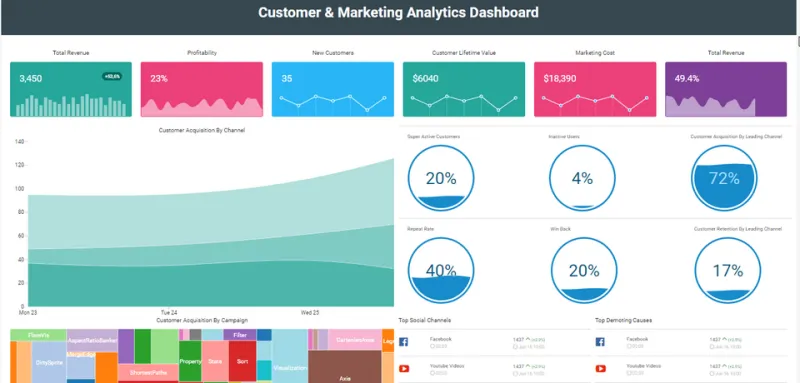
Photo: HelicalInsight OpenSourceBI, CC BY-SA 4.0, via Wikimedia Commons
Somewhere between the initial sales presentation and the third year of a BI platform contract, something goes wrong. The dashboards multiply. The custom data models accumulate. The backlog of reporting requests grows longer than the IT team can address, and the finance department quietly returns to spreadsheets because they can get answers faster that way. The enterprise analytics solution that was supposed to democratize data has instead created a new class of organizational bottleneck.
This is not a fringe experience. It is, in fact, one of the most consistent failure patterns in corporate technology adoption — and it is costing American businesses real money in ways that rarely appear on a single line item.
How Complexity Becomes the Default Setting
The trajectory is almost always the same. An organization purchases an enterprise BI platform — Tableau, Power BI, Qlik, or one of a dozen other capable tools — with genuine ambition. The initial use cases are well-defined: standardize financial reporting, reduce manual data preparation, give business leaders self-service access to key metrics. The early results are encouraging.
Then the requests start. The sales team wants a custom pipeline dashboard. The operations group needs a logistics view with six filtering dimensions. The CEO asks for an executive summary that pulls from four different data sources. Each request is reasonable in isolation. Collectively, they produce something far less functional than the sum of its parts.
Within eighteen to twenty-four months, many organizations find themselves managing a BI environment that requires dedicated developer resources simply to maintain existing dashboards, let alone build new ones. The platform that was sold on the promise of self-service has become anything but. And the users who were supposed to be empowered are instead waiting in queue for IT support.
Counting the Real Costs
The financial impact of over-engineered analytics infrastructure is difficult to quantify precisely, which is part of why it persists. The costs are distributed across budget lines and rarely aggregated into a single figure that triggers executive attention. But they are real, and they are significant.
Consider the direct costs first. Enterprise BI licenses are not inexpensive. When you layer in the implementation fees, the ongoing customization work, the data engineering support required to maintain integrations, and the training programs that must be refreshed every time the platform updates, the total annual cost of a mature BI deployment at a mid-market company can easily reach six figures — and frequently exceeds that threshold.
Then there are the indirect costs, which are harder to see but arguably more consequential. Decision latency is among the most damaging. When business leaders cannot get reliable answers from their analytics tools quickly, they either wait or they guess. Both outcomes have real operational costs. A regional sales director who cannot pull accurate pipeline data before a quarterly review is making decisions on incomplete information. Multiply that across an organization and the cumulative impact on decision quality is substantial.
Employee frustration is another underappreciated cost. Analytics professionals who spend the majority of their time maintaining broken data pipelines and troubleshooting dashboard errors are not generating the strategic insights their organizations hired them to produce. The opportunity cost of misallocated analytical talent is significant — particularly in a market where that talent is expensive and difficult to retain.
What Simplification Actually Looks Like
The instinct in most organizations, when analytics infrastructure fails to deliver, is to invest further in the existing platform — more customization, more training, more integration work. This is, in most cases, the wrong response. It treats the symptom rather than the cause, and it deepens the organization's dependency on a system that has already demonstrated its limitations.
A more productive approach begins with a disciplined audit of what the analytics environment is actually being used for. In practice, this exercise almost always reveals the same pattern: a small number of reports and dashboards account for the vast majority of actual usage, while a large portion of the custom-built infrastructure sits dormant or is accessed only sporadically.
One regional manufacturing company in the Midwest conducted exactly this audit after its IT director flagged a significant year-over-year increase in BI-related support tickets. The results were striking. Of the 340 dashboards the company had built over four years on its enterprise platform, fewer than 40 were accessed more than once per month by more than one user. The company had invested heavily in analytical infrastructure that served, in practice, a remarkably narrow set of use cases.
Armed with that data, the company's leadership made a deliberate decision to consolidate. They retired the majority of their custom dashboards, standardized on a smaller set of core reports with clearly defined ownership, and replaced several complex data integrations with simpler, more maintainable processes. The result was a meaningful reduction in IT maintenance burden, faster report load times, and — critically — higher user adoption rates among business leaders who had previously avoided the platform because it was too complicated to navigate reliably.
The Vendor Incentive Problem
It would be incomplete to discuss analytics complexity without acknowledging the role that technology vendors play in creating it. Enterprise BI vendors are incentivized to expand platform usage, not to optimize it. Their account teams celebrate new use cases, expanded deployments, and increased seat counts. They are not compensated for helping clients do more with less.
This misalignment of incentives is not unique to the BI industry, but it is particularly consequential in the analytics space, where the proliferation of features can be framed as capability expansion even when it is generating organizational friction. Procurement teams and IT leaders who evaluate BI platforms primarily on feature breadth are implicitly rewarding this behavior.
Organizations that have successfully avoided the complexity trap tend to share a common characteristic: they defined their analytical requirements with precision before selecting a platform, and they established governance structures that limited the scope of what the platform was asked to do. That discipline is difficult to maintain under the pressure of competing internal requests, but it is the single most effective defense against dashboard sprawl.
A Framework for Reclaiming ROI
For organizations that have already accumulated significant analytics debt, the path forward requires executive commitment and a willingness to make decisions that will generate short-term resistance.
Start by establishing clear ownership for every dashboard and data model in the environment. If a report cannot be assigned to a business owner who can articulate why it exists and what decisions it supports, it is a candidate for retirement. This single step, applied consistently, can eliminate a substantial portion of the maintenance burden in most BI environments.
Next, resist the temptation to solve complexity with more technology. Adding a data catalog or a governance layer on top of an already overbuilt platform is unlikely to produce meaningful improvement. The more effective intervention is subtraction — fewer dashboards, fewer data sources, fewer custom integrations.
Finally, measure the performance of your analytics infrastructure with the same rigor you would apply to any other operational investment. Track adoption rates, decision latency, and user satisfaction. If your BI platform is not improving those metrics, the investment deserves the same scrutiny you would apply to any underperforming asset.
The organizations that are winning with business intelligence in today's environment are not those with the most sophisticated platforms. They are those with the clearest sense of what they need analytics to do — and the discipline to hold that line.