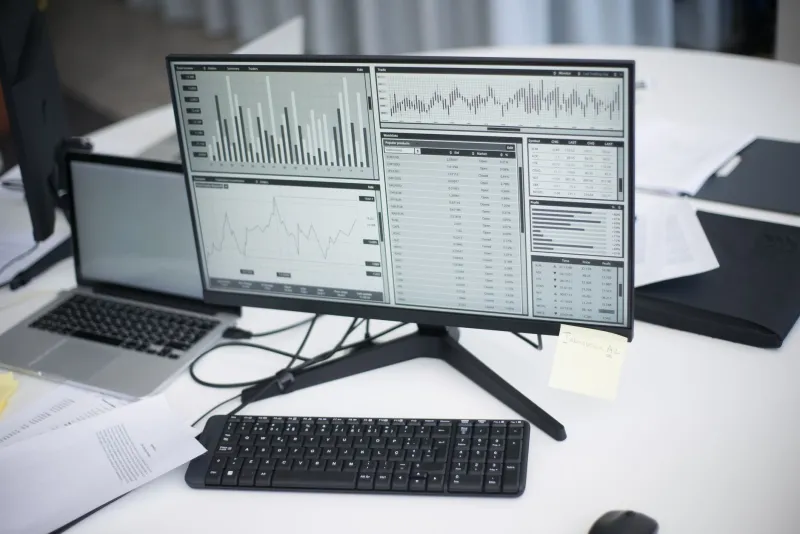
The Credibility Invoice: When 'Bring Data to the Meeting' Becomes an Unfunded Mandate

There is a moment familiar to managers across corporate America: the meeting invite lands, and somewhere in the body of the email sits the phrase that ruins the rest of the week — 'come prepared with numbers to back this up.'
For most of the twentieth century, that sentence meant pulling a report from the finance team. Today it means opening a BI tool you received two hours of training on, hunting through seventeen dashboards of uncertain provenance, exporting to Excel, and hoping the pivot table behaves. When it doesn't behave — when the numbers contradict a colleague's, or a figure cited in the meeting turns out to be six months stale — the manager absorbs the damage. Not the data team. Not the platform vendor. The manager.
This is what might be called the credibility invoice: a recurring charge levied against the professional standing of people asked to perform skilled analytical work without the support infrastructure to do it well.
The Improvised Analyst Economy
Organizations rarely describe it this way, but a quiet reallocation of labor has taken place over the past decade. As self-service analytics became the industry's dominant pitch, the implicit promise was empowerment. The implicit reality, in many firms, was offloading. Central analytics teams — often understaffed relative to demand — became backlogged with enterprise priorities, while routine questions migrated downward to whoever owned the meeting.
The result is an improvised analyst economy: operations directors, regional sales leads, and plant supervisors producing their own numbers on deadline, with no review layer, no documentation standards, and no second pair of eyes. It is the analytical equivalent of asking a shift supervisor to file the company's 10-K.
The economics are perverse. When the improvised analysis holds up, the credit flows to the culture of self-service. When it fails — a misapplied filter, a join that double-counts customers, a metric pulled from a deprecated dashboard — the failure attaches itself to the individual. And unlike most workplace errors, this one compounds. A manager whose forecast was wrong once in front of a VP carries that moment into every subsequent meeting.
Why the Mistakes Are Predictable
What makes this dynamic especially frustrating is that the failure modes are entirely foreseeable. They follow a short, well-worn list:
- Metric ambiguity. Two teams arrive with different definitions of 'active customer' or 'net revenue,' and the manager has no way to know which is canonical.
- Stale sources. Legacy dashboards survive long after the logic behind them has drifted from current business reality.
- No validation path. There is no quick, low-friction way to ask a data professional whether a number is trustworthy before it is presented.
- Time pressure. The analysis is due tomorrow, which guarantees shortcuts.
None of these are competence failures. They are infrastructure failures. Yet because the output is attributed to the person, the infrastructure is never the thing that gets fixed.
A Minimum Viable Support Standard
If companies are going to continue externalizing analytics onto the management layer, they owe that layer something in return. A reasonable standard would look like this:
A certified source of truth. Every metric a manager might be asked about in a meeting should trace to a governed definition, marked as such. If a number isn't certified, it should say so on its face.
A service-level response channel. A thirty-minute SLA for 'is this number right?' questions during business hours — staffed by real analysts, not a ticket queue with a five-day turnaround.
Certification for presenters, not just builders. Training should focus on the analytical tasks managers actually perform: reading a distribution, spotting a suspicious sample, articulating confidence levels. Not everyone needs to learn SQL; everyone who presents numbers needs to know when a number deserves a caveat.
Cover for uncertainty. Culturally, leadership should treat 'here's the range, and here's why I'm not confident in the point estimate' as a mark of rigor rather than weakness. The alternative — false precision delivered confidently — is how bad decisions get made in well-lit conference rooms.
The Cost of Doing Nothing
Some executives will read this and conclude the answer is simply better hiring: get managers who are 'data literate' and the problem solves itself. This is a comfortable fiction. The talent pool is finite, the demands keep rising, and the organizations that win on analytics will be those that stop treating data support as a personal virtue and start treating it as operational infrastructure.
The credibility invoice is being paid right now, in attrition, in hedged recommendations, in managers who pre-emptively disclaim their own analysis to survive the meeting. Every one of those behaviors is a tax on decision quality. Companies serious about being data-driven should ask a simple question: when a middle manager walks into a room with a number, what has the organization actually done to make sure that number deserves the weight it will carry?
Until there's a real answer, the embarrassment isn't the manager's. It's the institution's.